How intensively do you cook?
For a busy kitchen, consider acids, staining, hot cookware, cleaning frequency and whether using boards and trivets fits your habits.
ROYALSTONE · COUNTERTOP COMPARISON
Do not look for a universal winner. Choose the surface behaviour that fits your kitchen.
Marble and granite are both natural stones, but they respond differently to acids, staining, daily use and ageing. This guide compares practical criteria rather than slogans: the actual slab, finish, maintenance, geometry and the appearance you expect from the finished countertop.

Your answers narrow the field faster than dozens of small samples. The final decision should still be made from the actual slab.
For a busy kitchen, consider acids, staining, hot cookware, cleaning frequency and whether using boards and trivets fits your habits.
On marble, acid etching and changes in sheen may become part of the surface over time. If you want the appearance to remain very stable, account for this before buying.
Marble veining can become the main design feature; granite ranges from fine-grained to highly figured. Compare full slabs rather than relying on a small sample.
Polished, honed and textured finishes change both appearance and maintenance. The same stone can read very differently in another finish.
Sink, hob, long runs, islands and waterfall ends affect layout, reinforcement, seams and slab yield regardless of material.
For one client it means minimal attention; for another it means a natural surface that can be maintained and allowed to evolve. Define your own criterion first.
These are general natural-stone guidelines. The properties of the actual slab, its porosity, finish and fabrication quality still need to be checked.
| Criterion | Marble | Granite | Confirm before ordering |
|---|---|---|---|
| Acids | Calcite-based marble is sensitive to food acids: lemon, vinegar and some cleaners can leave a dull etched mark. | Most granites are much more resistant to common food acids, although the mineral composition of the selected stone still matters. | Ask for care guidance for the actual slab and finish. |
| Staining & sealing | Impregnating sealer may reduce absorption but does not make marble “impervious” and does not prevent acid etching. | Sealing needs vary by granite; a universal “once a year” schedule is not appropriate for every slab. | Confirm the porosity of the selected surface and whether sealing is recommended. |
| Scratches & chips | Marble is comparatively softer; using a cutting board and protecting edges remains sensible. | Granite is generally harder, but edges, corners and cut-out zones can still be damaged by impact. | Review edge geometry, radii, cut-out reinforcement and daily-use conditions. |
| Hot cookware | Natural stone tolerates household heat, but a trivet reduces thermal-shock risk and protects adjacent materials and finishes. | The same safe habit applies to granite: heat resistance should not become a reason to place very hot cookware directly on the surface. | Consider adhesives, sealants, substrate, thickness and nearby cut-outs. |
| Pattern & batch | Large veins can require detailed layout and approval of transitions between parts. | Colour and grain also vary slab to slab; highly figured granites benefit from the same layout discipline. | Approve photos/video of the actual slab and the cutting layout before fabrication. |
| Finish | Polishing increases depth and sheen; honed finishes change how marks and touch are perceived. | Polished, leathered and other finishes can differ in appearance and maintenance. | Ask for the finish you intend to buy, not just the stone name. |
| How the surface ages | Changes in sheen, small marks and patina may become part of the aesthetic of natural marble. | Granite often retains its original sheen longer, but seams, sealant and working zones still need maintenance. | Agree what an acceptable lived-in appearance means for you. |
Marble does not need to be “defended”. It works when you understand the material and are comfortable with its natural behaviour.
Marble is often selected for the pattern itself. On islands, backsplashes and long runs, the actual slab and transitions should be approved.
If natural signs of use are not treated as defects, marble can age attractively with the interior.
Sealer does not stop acid etching. Lemon juice or vinegar may alter the sheen even without leaving a stain.
Polished marble looks deeper; honed finishes may make small sheen changes less conspicuous, but they do not make the stone acid-proof.
Natural marble can often be professionally honed and polished, although the scope depends on the damage and construction.
A good choice starts with a clear discussion of care, finish, seams and the surface changes you are willing to accept.
Granite is not one uniform “no-compromise category”. Slabs vary in pattern, porosity, finish and behaviour, so the decision is still made stone by stone.
For a busy kitchen, many granites offer a useful balance of natural appearance and resistance to normal household use.
For most granites, lemon and vinegar do not create the same etching risk as they do on calcite marble.
Not every granite absorbs liquids to the same degree. Sealing decisions should follow the actual surface rather than a calendar.
Dark surfaces can show fingerprints and dust; light ones can reveal certain spills. Finish changes the visual effect too.
Stone hardness does not replace correct radii, reinforcement, support, seam planning and careful handling.
With Alaska White, Blue Pearl, Absolute Black and other stones, the batch, structure and actual slab appearance matter.
Two projects using the same commercial stone name can look very different. Confirm the execution, not just the material name.
Ask to see the whole slab and close details. A small sample cannot show the scale of veins, grain or local inclusions.
For a strong pattern, agree the focal areas, seams, waterfall ends and visible transitions before cutting.
Compare samples in lighting similar to the kitchen. Sheen, colour depth and the visibility of marks all change.
A small bevel, radius, profile or built-up thickness changes both the look and how exposed the edge is to impact.
Their number follows slab format, component length, carrying access and pattern — not only a request for “no joints”.
Exact models, templates, edge clearances and reinforcement are agreed before cutting for either material.
Catalogue images help establish a direction; completed projects show scale, edges, seams and how natural stone reads in a finished interior.
A dark, more uniform field makes the countertop geometry and edge treatment easy to read. The actual slab and finish are still confirmed before quotation.
View countertops ↗
A light granite with visible movement demonstrates why the complete slab should be reviewed and layout planned before cutting.
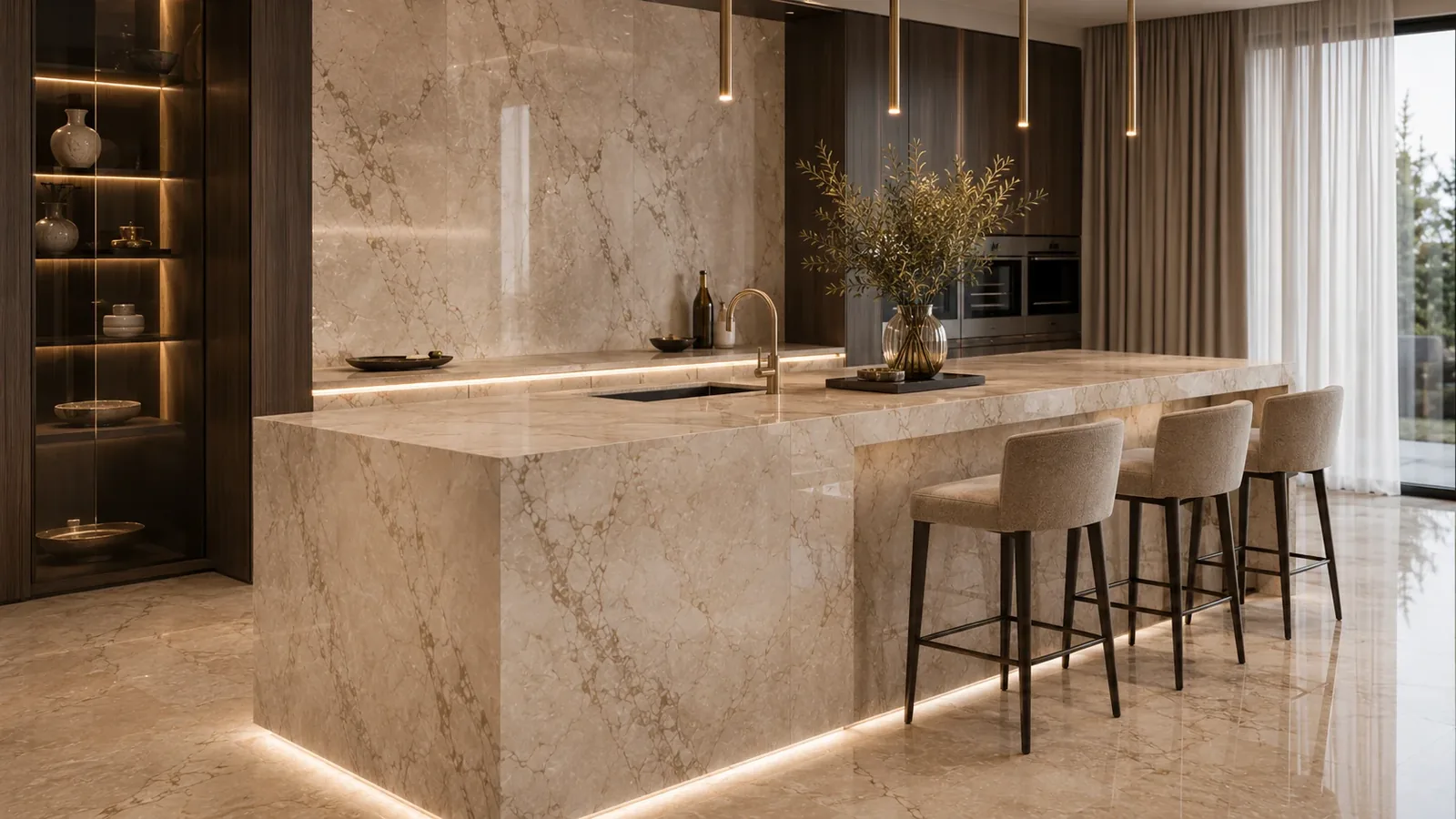
View granite ↗This light marble composition shows how proportions, precise junctions and clean edge work affect the finished interior.
View project ↗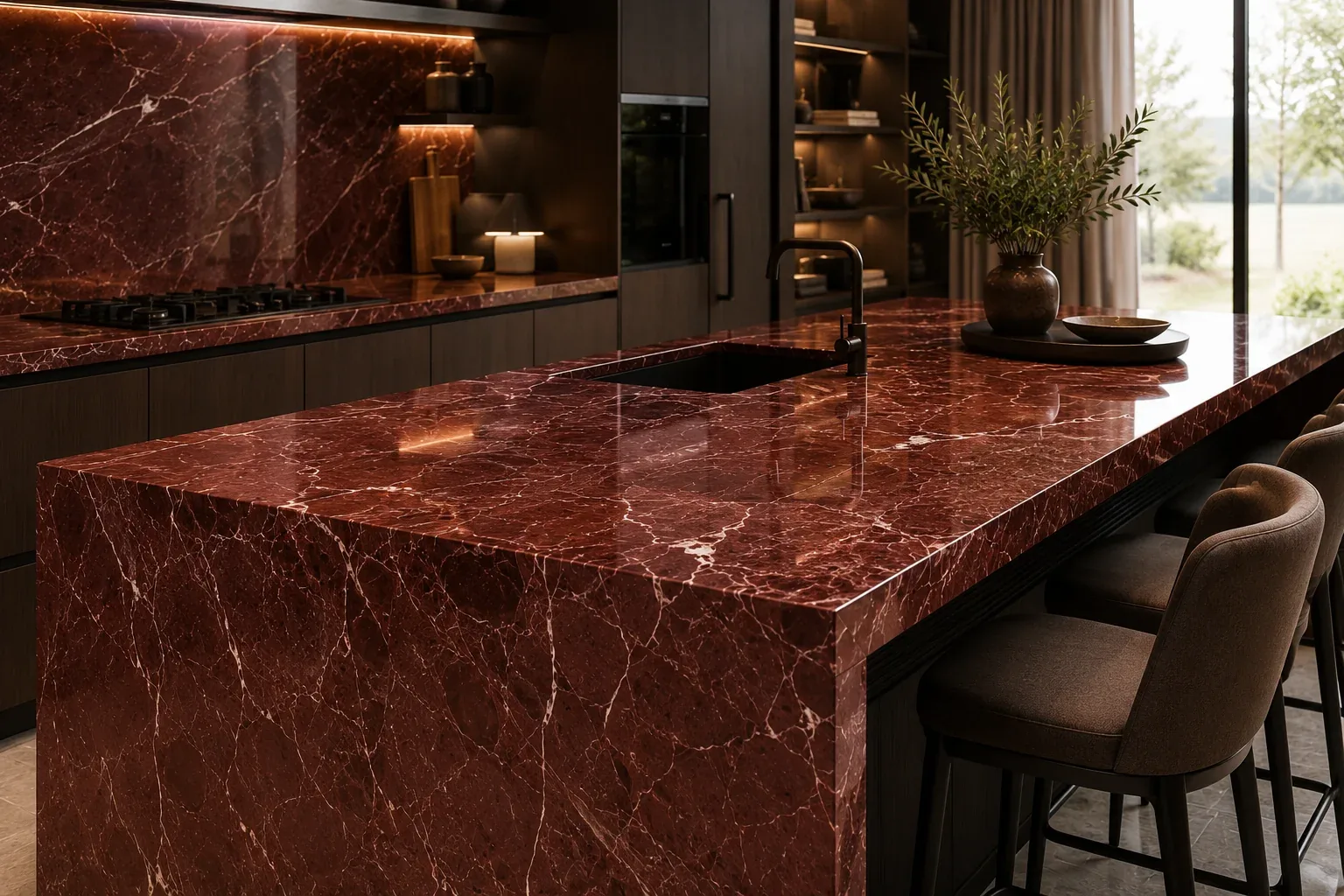
A high-contrast pattern makes every seam and transition more visible, so layout is agreed before fabrication.
View project ↗A reliable quotation is built around the actual slab and geometry. Compare offers only when the scope is genuinely the same.
The actual batch price, slab size, usable yield and number of slabs required all matter.
Vein matching, bookmatching or preserving a focal area can increase material usage.
Profiles, built-up thickness, bevels, radii and polishing change fabrication effort.
Sink, hob, tap, sockets and other openings require accurate drawings and finishing.
Long spans, large cut-outs, waterfall ends and seating areas can require additional structural solutions.
Floor, lift, door openings, component weight, interior protection and carrying complexity are considered separately.
Material is only one layer of the decision. Measurement, appliances, slab layout, edges, seams and carrying access still have to be resolved before fabrication.
For a hard-working surface, many clients consider granite because it is generally more resistant to household acids and wear. Marble is a deliberate design choice for its pattern and character, with more attentive care and possible patina accepted. The final choice should be made from the actual slab.
No. Impregnating sealer primarily reduces liquid absorption and staining risk; it does not make calcite marble immune to acid etching.
No. Need and interval depend on the actual stone, finish and absorption. A universal calendar is not a substitute for evaluating the surface.
Natural stone is heat resistant, but using a trivet is a sensible habit: it reduces thermal-shock risk and protects sealants, adhesives and adjacent materials.
A cutting board is better. It protects the surface and your knife edge, and reduces the chance of accidental impact near edges and cut-outs.
There is no universal winner. Polishing gives greater depth and sheen; honed finishes change touch and the visibility of marks. Compare the actual stone in lighting similar to your interior.
Natural-stone patterning is not perfectly repetitive. A full slab shows the scale of veins, grain, inclusions and the areas that need to be considered in the cutting layout.
Keep geometry, thickness, edge work, cut-outs, backsplash/end panels, delivery and installation the same. Then different slabs can be compared without hidden scope differences.
Technical guidance is summarised from Natural Stone Institute and Use Natural Stone resources. The actual slab, finish and maintenance products are confirmed separately.
ROYALSTONE
Send kitchen photos or a visualisation, approximate dimensions and the stone character you like. We can shortlist relevant slabs, explain maintenance, prepare an initial estimate and then move to precise measurement.