The actual stone
Tone, density, voids and pattern vary by lot. Final selection should be based on the actual material, not the name alone.
ROYALSTONE · TRAVERTINE GUIDE
Natural voids, two cutting orientations and different application scenarios.
Travertine is a natural limestone. Its appearance and performance depend on the actual stone, cutting orientation, treatment of natural voids, finish and conditions of use. This guide explains those choices before material selection and project pricing.
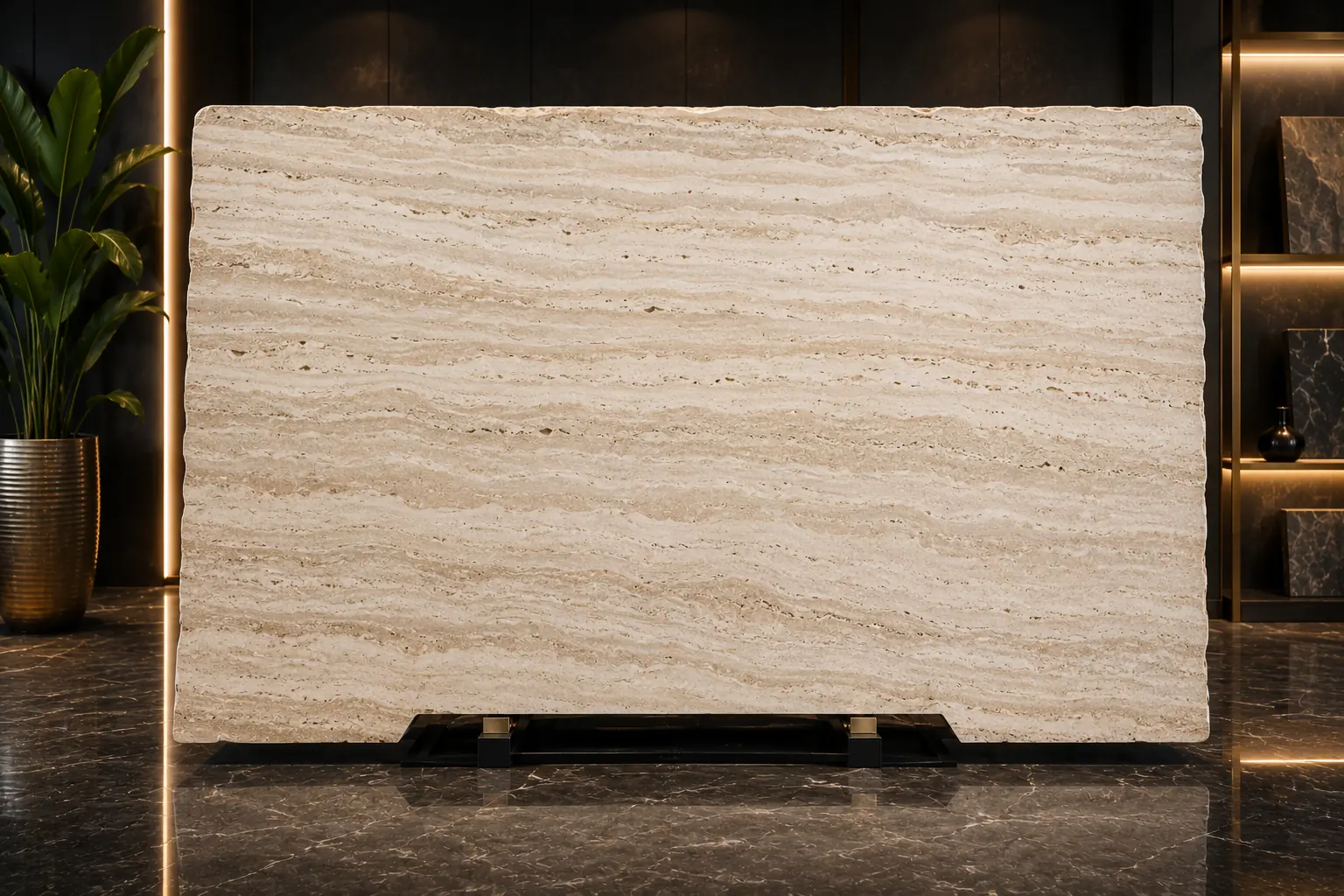
Tone, density, voids and pattern vary by lot. Final selection should be based on the actual material, not the name alone.
Vein cut crosses the natural bedding and exposes a linear pattern; cross cut runs parallel to the bedding plane and creates a softer, cloud-like pattern.
Filled/unfilled, honed, brushed or tumbled surfaces change appearance, tactility, slip characteristics and care requirements.
Walls, floors, stairs, fireplaces, wet areas and exterior use each have different requirements for finish, substrate and installation.
These terms describe how the stone is cut relative to its natural bedding. The orientation strongly changes the visible pattern.
A cut perpendicular to the natural bedding plane exposes several layers and creates pronounced parallel bands. The effect is especially visible on large vertical surfaces.
A cut parallel to the natural bedding plane creates a calmer cloud-like or mottled pattern, often chosen for more uniform areas and larger formats.
Natural voids are characteristic of travertine. They can remain open or be filled with a compatible material; the finish should suit the design and actual loading conditions.
Voids are filled to create a more even surface. Filler colour and composition should be confirmed for the specific stone and use case.
Open voids preserve the natural texture more strongly. This approach requires careful consideration of the location, detailing and maintenance method.
A calm satin-like finish used for many interior applications. The exact sheen and slip characteristics should be agreed before fabrication.
Brushed or aged finishes emphasise texture. Suitability depends on the design, traffic and cleaning method.
There is no universal rule that one travertine works everywhere. The actual stone, finish, substrate, joints and installation system should be checked for each application.
Travertine is a calcareous stone, so acidic products can damage the surface. An impregnating treatment can improve stain resistance, but it does not make the stone completely stain-proof.
Routine care should use neutral products compatible with natural stone, a soft cloth or non-abrasive cleaning tools.
Vinegar, citric acid and acidic bathroom cleaners can dull or etch a calcium-based surface.
An impregnator provides additional resistance to penetration of contaminants but does not make the stone stain-proof. Compatibility and frequency depend on the specific surface.
Deep damage, difficult stains or etching are better assessed professionally rather than treated with aggressive household chemicals.
A material price per square metre is not the finished-project price. A fair comparison should account for the stone, layout, finishing, fabrication, logistics and installation on the same basis.
The specific lot, tone, thickness, slab or tile format, origin and confirmed availability.
Part dimensions, pattern direction, joints and waste determine the real amount of material required.
Filled/unfilled, honed, brushed or tumbled surfaces have different fabrication requirements.
Edges, build-ups, cut-outs, stair parts, radii and visible returns are priced from the drawing.
Weight, access, lifting, substrate preparation, joints and final fitting form a separate part of the estimate.
General classification and care guidance is based on Natural Stone Institute resources. These references do not replace evaluation of the actual stone or the project details.
ROYALSTONE · KYIV
Send photos, drawings or approximate dimensions. RoyalStone can help define the format, cut orientation, void filling, finish and fabrication scope before an accurate quote.