Waterfall sides and pattern continuity
Decide whether the veining should continue from the top onto side panels. Ask to see all visible parts laid out on the actual slabs: a shared stone name does not guarantee a continuous pattern.
ROYALSTONE · KITCHEN GUIDE
Your habits first. The stone comes next.
A beautiful sample is only the beginning. For a working kitchen, consider how you cook, what you expect from the surface and how much care you are comfortable providing. Compare four materials, then agree the actual slab, drawings and quotation.
Selection, fabrication and installation · Kyiv and region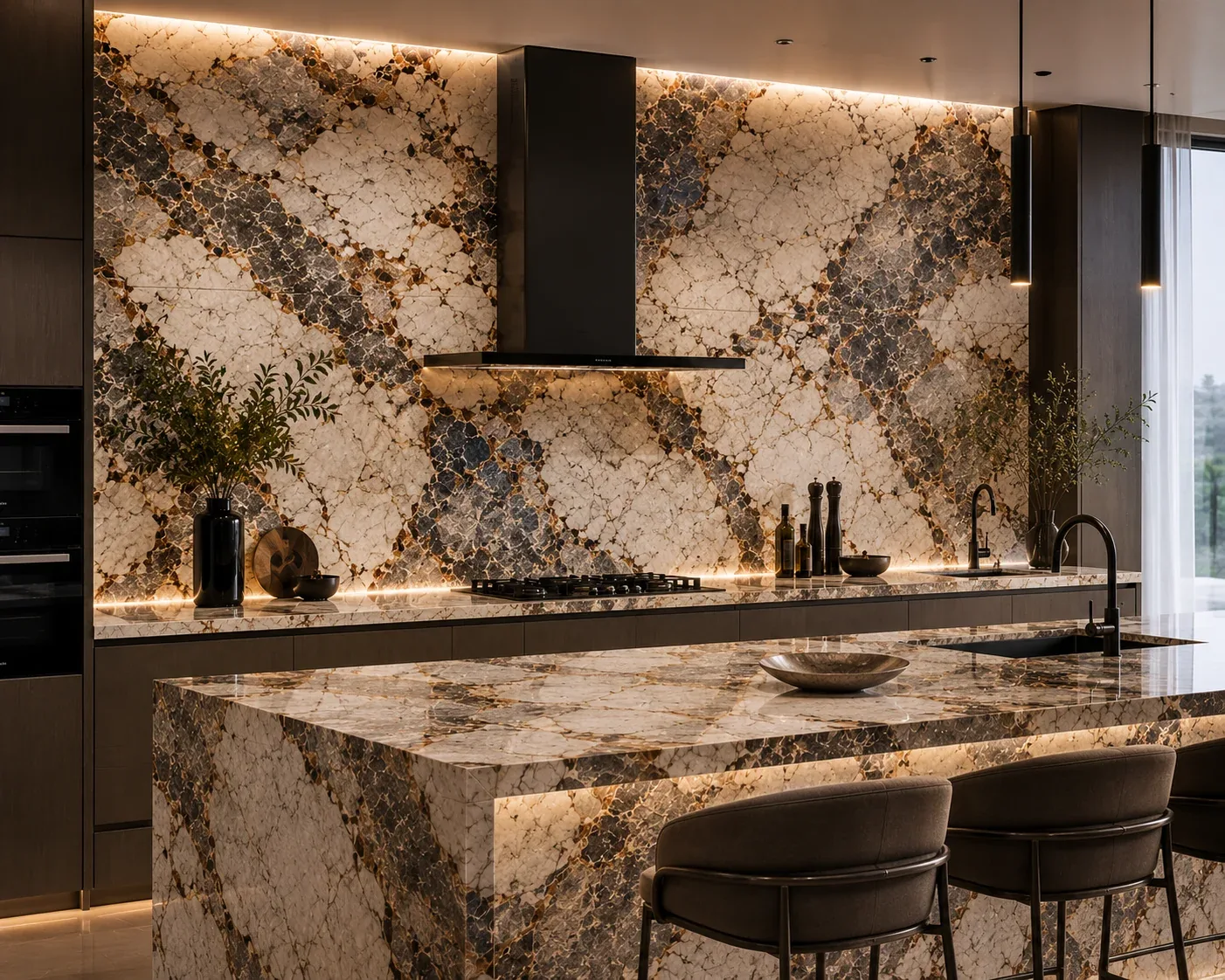
Start with a priority rather than a trade name. These are starting points for a discussion, not an automatic material ranking.
Start by comparing granite, verified natural quartzite and engineered quartz. Discuss the care routine and handling of hot cookware separately.
Consider whether you can accept signs of use and protect the surface from food acids. Its beautiful pattern does not remove these limitations.
Compare photographs of whole slabs and the proposed top-and-side layout. A small sample cannot show the complete composition.
Look at a specific engineered-quartz brand, colour and finish. Check available formats, the pattern and the instructions, not just the word “quartz”.
This table explains general differences. Confirm the properties of the specific batch, finish and fabricated product before ordering. Prices are not ranked here: compare quotations for the same geometry.
| Material | When to consider it | Limitations and care | What to agree |
|---|---|---|---|
| Marble ↗ | When natural veining, the feel of the stone and a coordinated interior are your main priorities. | Calcite-rich stone is sensitive to acids. An impregnating stain repellent does not remove the risk of dull etch marks from lemon or vinegar.[1] [3] | The actual slab, finish and willingness to follow a gentle care routine. Discuss what changes in appearance you can accept over time. |
| Granite ↗ | As a natural material for a working kitchen when its colour and structure suit the design. | Care and sealing needs depend on the stone. Not every granite countertop needs sealing; “stain-proof” is not a universal guarantee.[2] [4] | The selected slab’s porosity, finish, edge and installation. Trivets and cutting boards remain useful precautions. |
| Natural quartzite ↗ | When you want natural stone with a pattern appropriate for the kitchen. | It is not engineered quartz. Porosity and protection needs vary; the label “soft quartzite” alone does not establish composition.[5] | Material identity, the particular slab’s properties and protection of edges and cut-outs. Do not transfer promises from another trade name. |
| Engineered quartz ↗ | When you want a manufactured material from a chosen collection with documented use instructions. | This is an engineered material, not a natural quartzite slab. Caesarstone requires trivets for hot cookware and the use of a cutting board for its surfaces.[5] [6] | Brand, product code, finish, batch and current instructions. One manufacturer’s advice does not replace another’s requirements. |
Patagonia and Taj Mahal appear in our quartzite catalogue. Bianco Carrara and Calacatta Gold are marble examples; for a working kitchen, consider marble’s limitations as well as its appearance.
Across a large surface, the pattern, supports, joints and delivery access all matter. Make the final decision from working drawings, not a universal dimension found online.
Decide whether the veining should continue from the top onto side panels. Ask to see all visible parts laid out on the actual slabs: a shared stone name does not guarantee a continuous pattern.
Consider the seating overhang, span, thickness, natural features and cut-outs together. Do not approve an arbitrary overhang without assessing the cabinetry and any reinforcement required.
Exact appliance models and installation drawings are needed before cutting. Plan service access, ventilation required by the appliances, fixings and junctions.
A preference for one piece must be considered against slab size, pattern direction, doors, lifts and the delivery route. Agree the number and position of joints before fabrication.
Three separate projects: Patagonia in Rudyky, Crema Marfil Extra in Kyiv and Rosso Levante in Bucha. The photographs show application and pattern, not comparative material-test results.
Patagonia quartzite kitchen island and backsplash. Material: Patagonia quartzite. Location: Rudyky, Kyiv Region.
Explore this project ↗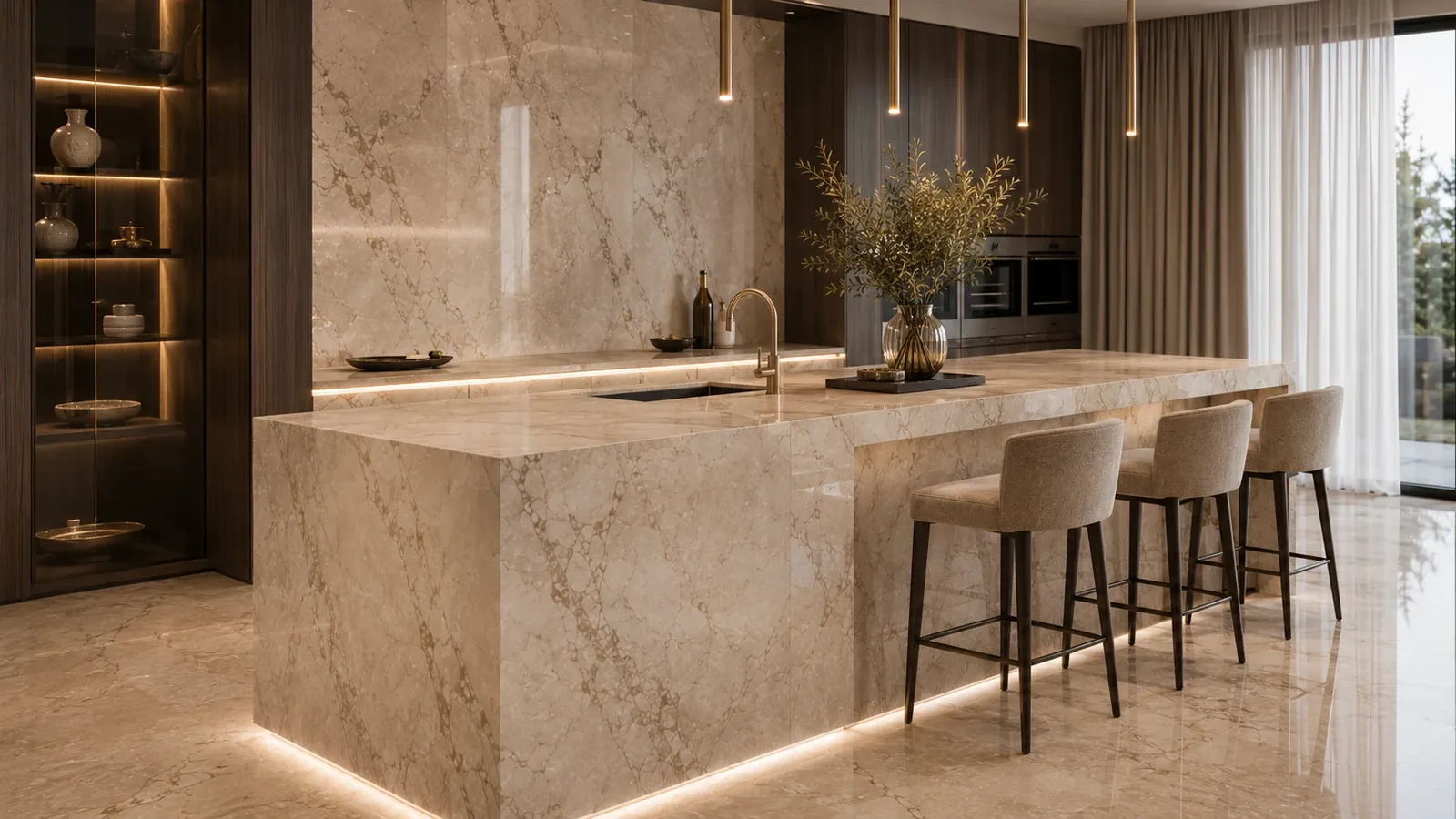
Light marble kitchen island — Crema Marfil Extra. Material: Crema Marfil Extra marble. Location: Kyiv.
Explore this project ↗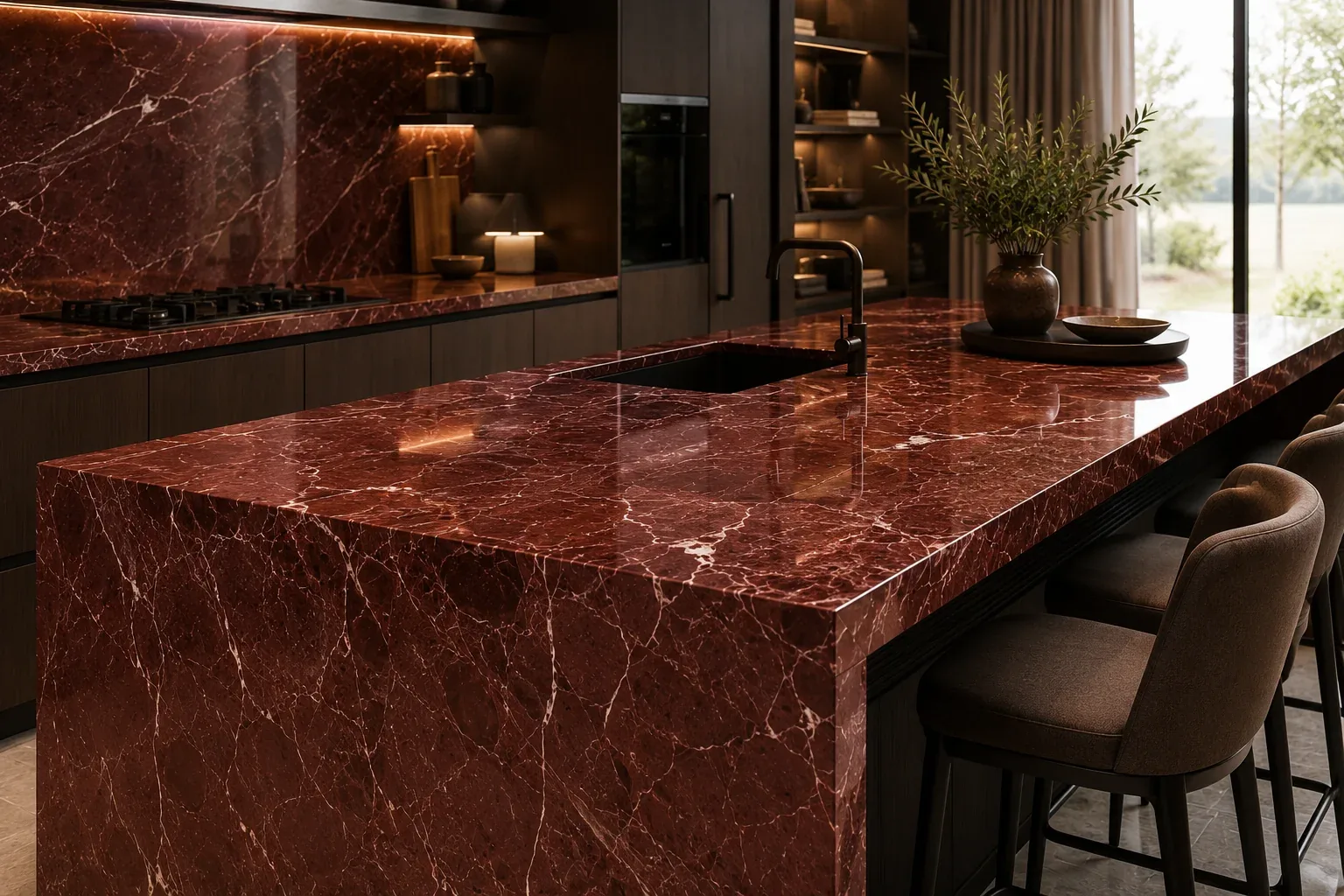
Red marble kitchen island — Rosso Levante. Material: Red marble Rosso Levante. Location: Bucha, Kyiv Region.
Explore this project ↗Quotations may include different work. For a fair comparison, send each fabricator the same configuration and request separate identification of material, fabrication, cut-outs, delivery and installation.
An initial plan starts the conversation. Final cutting and cost require confirmation of the material, site measurement and drawings; this guide contains no stock statement or public price offer.
Clean up spills promptly and use a cutting board and a trivet. Choose a neutral cleaner for natural stone and a manufacturer-approved product for engineered quartz. An absorbed stain and a dull acid etch are different problems. Select the treatment only after identifying the cause. [1] [3] [6]
It can be considered when its appearance and feel matter and attentive care is acceptable. For intensive cooking, compare alternatives and discuss acid-etching risks before ordering.[3]
There is no reliable answer without a particular slab, geometry and work scope. Compare the same drawings, edges, cut-outs and installation rather than the raw material price alone.
No. It may reduce absorption of staining substances, but does not make stone invulnerable. Decide whether and how often it is needed for the specific material and treatment.[2]
That depends on slab format, geometry, supports and logistics. Joint locations and pattern transitions should be shown on the approved drawings.
A kitchen plan or photograph, approximate dimensions, preferred material, sink and appliance models, and the installation location. Note whether side panels, a backsplash and seating are required.
Tell us what matters most: everyday practicality, a particular pattern or coordination with the interior. We can then discuss the material, configuration and an initial estimate.
General care information was checked against Natural Stone Institute resources and Caesarstone documentation. Project photographs and descriptions are RoyalStone materials. Selection scenarios and the quotation checklist are an editorial consultation framework, not a laboratory ranking. The requirements for the actual manufacturer and material take priority.
Prepared 26 September 2026